
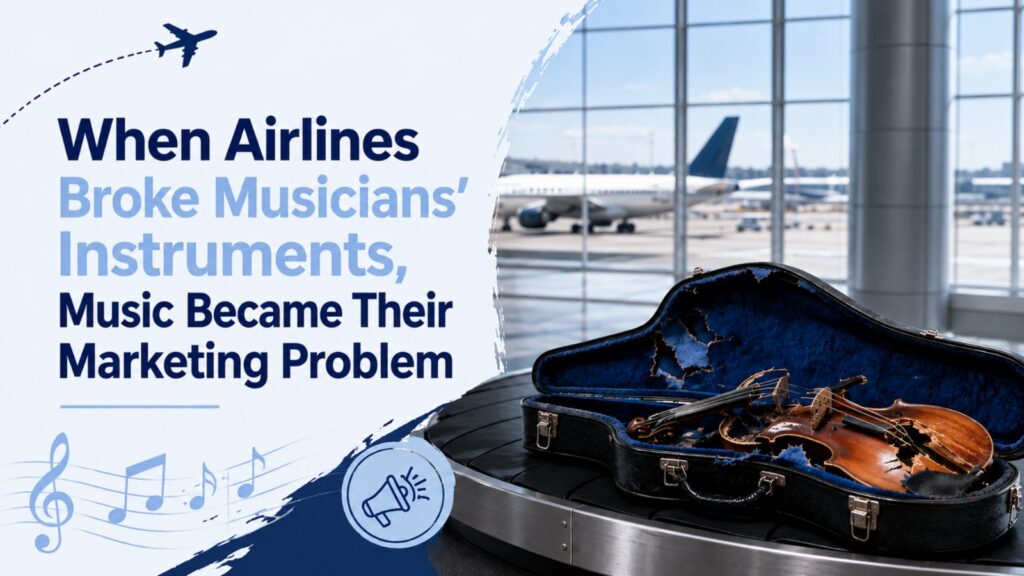
For an airline, baggage handling is usually an operational function. A passenger checks in a bag, the airline transports it, and the passenger collects it at the destination. But what happens when the baggage isn’t just a suitcase? What happens when it is a musician’s most valuable possession—an instrument that is not merely an object, but a part of their identity, profession, and livelihood?
Over the years, three musicians found themselves in remarkably similar situations. Their instruments were damaged while travelling with airlines. But instead of limiting their complaints to customer-service desks and claim forms, they did what musicians do best: they turned their experiences into songs.
Tom Paxton, Dave Carroll, and Bing Futch each used music to tell the world about their experiences with airlines. Their stories offer a fascinating lesson in marketing, customer experience, reputation management, and the power of storytelling.
Because when a customer is unhappy, the biggest risk for a brand isn’t always the complaint.
Sometimes, it is what the customer does with the complaint.
Tom Paxton and “Thank You Republic Airlines”
Long before social media and YouTube transformed customer complaints into viral content, American folk singer-songwriter Tom Paxton found himself dealing with a damaged guitar after travelling with Republic Airlines in 1985.
Paxton responded in a way that only a musician could. Rather than simply writing a letter of complaint or making a private claim, he turned the experience into a song titled “Thank You Republic Airlines.”
The song became his way of documenting what had happened and expressing his frustration. What might otherwise have remained a private customer-service dispute was transformed into a piece of public storytelling.
Listen to Tom Paxton’s “Thank You Republic Airlines”
From a marketing perspective, this is an early example of something that has become enormously powerful in the digital age: turning a customer experience into content.
Republic Airlines may have been dealing with one dissatisfied passenger. But Paxton had something the airline did not have—a creative medium through which he could communicate his experience to an audience.
The lesson for brands is simple. A customer complaint is not always just a complaint. It can become a story, a review, a social media post, a video, a meme, or, in Paxton’s case, a song.
The difference between a private complaint and public storytelling is enormous. A complaint sits inside a company’s customer-service system. A story can travel far beyond it.
And this was happening decades before brands had to worry about Twitter, Instagram, TikTok, or YouTube.
Tom Paxton’s story was, in many ways, an early warning of what the internet would eventually make commonplace: customers now have the ability to become their own media companies.
Dave Carroll and “United Breaks Guitars”
If Tom Paxton’s story was an early example of a customer using music to tell his story, Dave Carroll’s experience became one of the most famous examples of customer-generated content in the history of modern marketing.
In 2008, Canadian musician Dave Carroll and his band, Sons of Maxwell, were travelling from Halifax to Omaha, Nebraska, via Chicago, when Carroll’s guitar was damaged while in United Airlines’ custody. According to Carroll’s account, passengers witnessed baggage handlers mishandling guitars during the stopover. When Carroll arrived at his destination, he discovered that his Taylor guitar had been badly damaged.
What followed was not simply a story about a broken guitar. It was a story about the customer experience that followed.
Carroll spent months attempting to get United Airlines to take responsibility for the damage. After his efforts failed to produce the resolution he wanted, he decided to do something different.
He wrote a song.
That song was called “United Breaks Guitars.”
Watch Dave Carroll’s “United Breaks Guitars”
The song and its accompanying video went viral, transforming a dispute between one customer and one airline into an international conversation about customer service and corporate accountability. Carroll’s story became so widely known that it has since been discussed as a classic case study in the power of social media, word-of-mouth, and customer-generated content.
From a marketing perspective, “United Breaks Guitars” demonstrates a fundamental shift in the balance of power between brands and customers.
For decades, companies controlled their advertising. They decided what to say, when to say it, and how the public should perceive them.
The internet changed that.
Now, customers can tell their own stories.
And sometimes, those stories are more powerful than millions of rupees spent on advertising.
United Airlines could spend millions promoting its brand, its destinations, and its customer experience. But one unhappy customer with a guitar, a camera, and a song managed to create a conversation that the airline itself did not control.
The marketing lesson is not simply “never break a guitar.”
The real lesson is never underestimate the storytelling power of an unhappy customer.
If a customer complains privately, a company has an opportunity to resolve the issue quietly. But if that customer feels ignored, dismissed, or mistreated, they may look for another way to be heard.
And in the digital era, everyone has a microphone.
Bing Futch and “Only A Northwest Song”
Just months after Dave Carroll’s story began gaining attention, another musician found himself facing a similar problem.
Bing Futch is a musician whose primary instrument is the mountain dulcimer. On June 14, 2009, he was travelling on Northwest Airlines from Detroit to Fort Wayne for a performance when his double-neck mountain dulcimer was damaged. Futch subsequently wrote and recorded “Only A Northwest Song,” drawing inspiration from the earlier stories of Tom Paxton and Dave Carroll.
Watch Bing Futch’s “Only A Northwest Song”
What makes Futch’s story particularly interesting from a marketing perspective is how clearly it demonstrates the network effect of storytelling.
Tom Paxton had already shown that a musician could turn an airline experience into a song.
Dave Carroll had taken that idea into the age of YouTube and demonstrated just how far such a story could travel.
Then Bing Futch joined the conversation.
His song did not exist in isolation. It became part of a larger narrative about musicians, musical instruments, airlines, and baggage handling.
Futch himself acknowledged the connection, referencing both Paxton’s “Thank You Republic Airlines” and Carroll’s “United Breaks Guitars” in his song. He also wrote about the experience after seeing Carroll’s video and hoped that his own song would help bring attention to his situation.
And once again, the story attracted attention.
According to Futch’s account, the situation changed after his video gained attention and the company behind Northwest Airlines reached out with apologies and an offer of compensation. At the time, Northwest had been acquired by Delta Air Lines, adding another layer to the story of how a customer complaint moved from an individual claim into the public sphere.
The marketing lesson here is particularly important.
One customer’s story can inspire another customer’s story.
And once a pattern begins to emerge, the brand is no longer dealing with one isolated incident. It is dealing with a narrative.
That is where reputation management becomes critical.
A single unhappy customer can be dismissed as an isolated case.
Two or three similar stories can start to look like a pattern.
And once the public begins to believe there is a pattern, the brand has a much bigger problem on its hands.
The Marketing Lesson: Your Customer Can Become Your Media Channel
The stories of Tom Paxton, Dave Carroll, and Bing Futch are separated by decades, different airlines, and different musical instruments. But they share one common thread.
Each musician experienced a problem.
Each had a story to tell.
And each used music as the medium.
For marketers, this is an incredibly important lesson.
Your brand is not the only one creating content about your brand.
Your customers are doing it too.
They are writing Google reviews.
They are posting on Instagram.
They are making TikToks.
They are uploading YouTube videos.
They are posting on Reddit.
They are creating memes.
And, sometimes, they are writing songs.
The traditional marketing funnel used to be relatively simple: a company created a message, distributed it through advertising, and customers consumed it.
Today, the funnel is much more complicated.
A customer experience can become content.
Content can become a story.
A story can become a conversation.
A conversation can become a movement.
And a movement can become a reputation problem.
The three musicians also demonstrate something else: the importance of speed in customer service.
When a customer raises a complaint, the company should not only ask, “How much will it cost us to resolve this?”
It should also ask:
“What happens if we don’t resolve this?”
The cost of compensation might be ₹50,000.
The cost of a damaged reputation could be far greater.
Of course, not every customer complaint will go viral. Most won’t. But brands should never assume that a customer’s complaint will remain private.
The question is not whether every complaint will become a viral song.
The question is whether the company is willing to take that risk.
The Best Marketing Is Sometimes Not Marketing
There is an even deeper lesson here for airlines and, indeed, for every business.
The best reputation management strategy is often not a clever PR campaign.
It is good customer service.
You can spend millions building a brand around reliability, care, trust, and customer experience. But if your actual customer experience contradicts that promise, customers will notice.
And when they do, they will tell others.
Tom Paxton used a song to tell his story.
Dave Carroll used a song and YouTube to tell his story.
Bing Futch used a song and the emerging power of online video to tell his story.
None of them needed a marketing agency to create the campaign.
The customers created the content themselves.
And that is perhaps the biggest lesson for brands today:
You can control your advertising.
You cannot fully control your customers’ stories.
The best thing you can do is create an experience worth talking about—and when something goes wrong, fix it before your customer feels compelled to pick up a microphone.
Because sometimes, the difference between a ₹50,000 compensation claim and a global reputation crisis is simply this:
How quickly did you listen?